
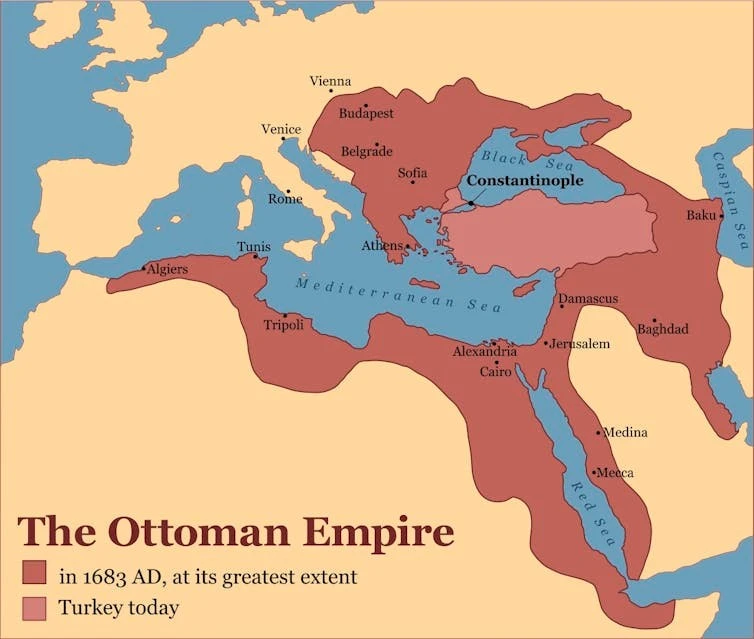
On October 3, 2017, Devlet Bahçeli, the leader of the Nationalist Movement Party (MHP), opposed the Kurdistan Regional Government's independence referendum, stating, "Right after Düzce '81, no power will stand in the way of your right to say '82 Kirkuk,' '83 Mosul." With this statement, Bahçeli essentially implied that by naming Turkish provinces as sequential license plate numbers 81, 82, and 83, he positioned Kirkuk and Mosul as provinces that could eventually be annexed to Turkey. Furthermore, Bahçeli added, "5,000 nationalists are waiting ready to go to Kirkuk." In other words, Bahçeli wanted to convey the message that Kirkuk and Mosul were Turkish territory and that Turkey could establish ties with these lands if necessary. This statement sparked significant debate at the time. However, the point I want to draw attention to here is quite different. Behind this discourse lies the Ottoman strategy of conquest and territorial integration. In other words, the logic of inclusion (integration). (14th-20th centuries) The Ottomans made almost every region they conquered an integral part of the state (memalik-i Osmaniye). Every region, from Rumelia to the Arab provinces, was integrated into the taxation, legal and military systems. Here, the British-style "distinction between center, homeland and colonies" never existed. This model was successful in the 16th and 17th centuries because territorial expansion was considered a significant element that increased the power of the state. However, in the 18th and 19th centuries, this model started to lose ground. As the territory grew, administrative costs increased. (Problems of communication, transportation, army coordination) Nationalist movements began. (Greek 1821, Serbian 1830, Bulgarian 1878) These nationalist movements created a separation from the center. At the end of the day, with the industrialization of Europe: The Ottoman Empire fell behind both militarily and economically. What I want to point out here is; The integration model was never flexible. When a province rebelled, it resulted in a breakaway from the state. In other words, the Ottoman Empire lacked the "I'll lose the colonies, but the center will remain intact" mentality, as in England. This model led to the disintegration of the Ottoman Empire in the 19th and 20th centuries. The homeland was directly affected. The losses, which began in the Balkans (1912-13), quickly spread to Istanbul.
Now when we look at 16th-20th century England; the colonial strategy was dominant here. (I.e., an empire model based on the distinction between center and periphery) Since the 16th century, England had followed a strategy based on the distinction between a central homeland (metropolis) and peripheral regions (colonies). In other words, the homeland was the British Isles. The peripheries were India, Canada, Australia, Africa and the Caribbean colonies. In other words, the colonies were never legally considered British territory and were governed by companies (East India Company) or governors. With this management model, economic and military resources were transferred to the center. When we look at the strategic result here; since the central homeland remained geographically small, its defense became easier. In the event of the loss of the colonies, the homeland was never in danger. (Loss of the American Colonies 1776, loss of India 1947) England's loss here was not through its central territories, it only lost its overseas dominance. Now, when viewed from this context; Bahçeli's rhetoric is essentially translating into a perception of geopolitical risk. In other words, the country's growth will essentially be tantamount to its fragmentation. This is because defending vast borders is difficult. Differing ethnic sectarian structures within the country make governance even more difficult. Ultimately, external powers manipulate these conflicts. History offers countless examples of this. These dynamics were also evident in the late Ottoman period. Therefore, to avoid repeating the same mistakes, it is critical that the British-style colonial model be revised, adapted to 21st-century conditions, and transformed into a strategy.
When we look at Turkey's current situation, Turkey is a nation-state. That is, it does not currently possess an imperial structure like the Ottoman Empire. Today, the implementation of the colonial model is no longer legally possible. The expansion and integration model also failed in the past. Therefore, the model I will refer to as a regional influence strategy is the current replacement for the British colonial model. So, what is a regional influence strategy? A regional influence strategy is a state's effort to establish a sphere of influence (sphere of influence) through economic, military, diplomatic, and cultural means, without directly annexing territory in neighboring or nearby regions. This model is a modern method of power projection that has replaced colonial or imperial models in the 21st century.
Here, establishing a guiding influence over surrounding countries, rather than control, is more critical. The primary objectives are to limit rivals' entry into the region, deepen security, increase economic opportunities, become a decisive power in regional decision-making processes, and prevent instability in surrounding countries from spilling over into the country. In this context, states no longer establish hegemony but instead cultivate influence. When we look at the tools of regional influence: Military means (military bases in foreign countries, joint exercises, security agreements, operational presence, Economic means; investments, corporate acquisitions, trade dependencies (energy, food, water, transportation), credit and financing programs, infrastructure construction (ports, highways, power lines), Diplomatic means; (mediation role, leadership in regional organizations, bilateral strategic partnerships), Soft power; educational scholarships, cultural institutes, media influence, use of religion and historical ties, etc.) In short, traditional colonialism was a model of domination based on territorial annexation and direct rule, establishing a forced hierarchy through colonial governors and maintained through military occupation. In contrast, today's regional influence strategy is based on states exerting influence without officially annexing the territories of other countries, by cooperating with their local governments and creating mutual but asymmetric dependencies. In this model, instead of permanent occupations, military bases, strategic agreements, economic investments and security cooperation are emphasized. Therefore, in the modern international system, no one can anymore establish classical colonies as in the example of India; However, it can become an effective power only by establishing political, military, and economic influence within the same country.
Turkey's current regional influence strategy is not based on direct territorial annexation, but rather on establishing military, economic, and diplomatic spheres of influence in surrounding regions. President of the Republic of Turkey Recep Tayyip Erdoğan's consistently reiterated motto, "We have no eyes on a single inch of anyone's land," stands out as the fundamental principle of this strategy; in other words, rather than invading other countries, Turkey aims to establish security and interests through cooperation and influence. Within this framework, the Turkish base in Qatar, the naval base in Somalia, and military training facilities enable Turkey to establish a continuous security presence in the Gulf and the Horn of Africa, while the cross-border security zones established in Syria and Iraq aim to eliminate terrorist threats and create strategic depth on its southern borders. While the military support provided to the Government of National Accord in Libya gives Ankara political weight in the western-central Mediterranean region, Military advisory and joint exercises provided to Azerbaijan reinforce its power projection in the Caucasus. Economic investments and cultural initiatives in the Balkans enhance the soft power capacity sustained through historical ties with the region. Furthermore, energy diplomacy in the Eastern Mediterranean strengthens Turkey's influence over maritime jurisdictions and energy corridors, becoming a key complement to this strategy. In other words, Turkey aims not to acquire territory, but to establish a security perimeter and sphere of influence. This model is not integration (incorporation) like the Ottomans, but rather a modernized version of Britain's 19th-century center-periphery logic. In short, a regional influence strategy is a country's ability to become a "controlling but not possessing" power in its immediate region. This is the most effective expansion and security mechanism for states in the modern world.